

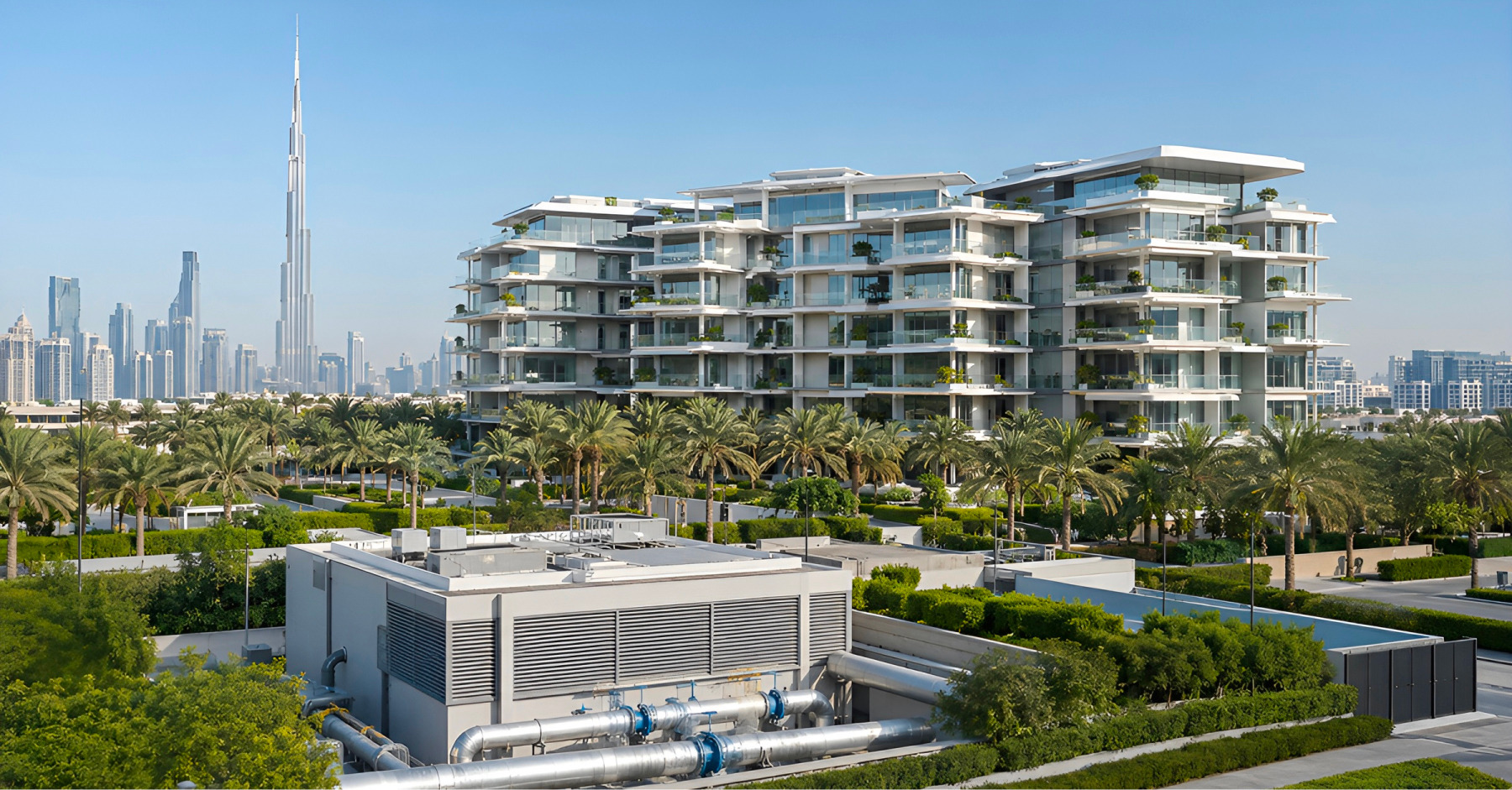
When renting a home in Dubai, understanding how your cooling is billed can make a meaningful difference to your overall living costs. Two terms you are likely to come across are “district cooling” and “chiller-free.” While they may sound technical at first, knowing the difference before signing your tenancy contract can help you plan your expenses with greater clarity and confidence.
The District Cooling System
District cooling is a centralized air-conditioning system designed to efficiently cool multiple buildings through a shared network.
Instead of each apartment operating its own outdoor compressor, a central plant chills water and circulates it through insulated underground pipes to individual buildings. Within each home, fan coil units use the chilled water to cool the air.
In Dubai, district cooling services are provided by companies such as Empower, Emicool, and Tabreed, as well as developer-operated networks such as Emaar’s.
If your building uses district cooling, you will typically receive two separate monthly bills: one from DEWA for electricity and water and another from the cooling provider. The cooling bill generally includes your usage, along with a fixed capacity charge that applies regardless of how much cooling you use.
What Does Chiller-Free Mean?
Unlike district cooling, chiller-free refers to how cooling costs are handled rather than the technology itself. In this arrangement, the landlord covers the cooling charges and incorporates them into the rent, meaning tenants do not receive a separate bill from a district cooling provider.
Instead, tenants typically pay their rent along with the standard DEWA bill for electricity, lighting, appliances, and water. As chiller-free arrangements can vary by building or individual unit, it is always worth confirming the terms directly with the landlord or agent and checking the tenancy contract before signing.
Understanding the Cost Difference
District cooling is generally more energy-efficient than individual AC systems, although this does not always mean lower costs for tenants, particularly when fixed capacity charges are included.
Market estimates indicate that district cooling can cost around 40–60% more than chiller-free arrangements, with some two-bedroom tenants potentially saving AED 10,000–15,000 a year with chiller-free homes.
However, the arrangement can be more costly for landlords, who typically take on higher energy expenses when using standalone cooling systems, which are less efficient at scale.
Understanding how these costs are structured can help tenants make a more informed choice when comparing rental properties in Dubai.
Which Areas in Dubai Have District Cooling
Cooling arrangements can vary across Dubai, but the following are common examples:
District cooling by Empower: Business Bay, Palm Jumeirah, JBR, JLT, Dubai Silicon Oasis, Al Khail Gate, and Ghoroob Mirdif.
District cooling by Emicool: Dubai Investment Park, Dubai Sports City, and Motor City.
District cooling by Tabreed: Downtown Dubai.
Typically chiller-free: JVC, Discovery Gardens, International City, Al Furjan, Mirdif, older sections of Dubai Marina and JLT built before 2008, and many villa communities, including Arabian Ranches, The Springs, and The Meadows.
These are general patterns rather than fixed rules. Cooling arrangements can differ between buildings and even individual units within the same community. For example, newer towers in JVC are increasingly connected to Empower’s network, so it is always worth confirming the cooling arrangement before signing a tenancy contract.
Which Cooling Arrangement is Right for You?
The right cooling arrangement ultimately comes down to your priorities and how you prefer to manage your monthly costs. Tenants who value predictable expenses may find chiller-free arrangements appealing, while district cooling can be a strong option for those who value energy efficiency and are comfortable managing a separate cooling bill.
Before signing a tenancy contract in Dubai, ask how cooling is billed and ensure the arrangement is clearly stated in the contract. A little clarity upfront can make for a more comfortable and predictable rental experience, especially during the summer months.
Sources
Gulf News, Explainer on district cooling vs. chiller-free arrangements and how billing works for tenants.
Property Finder, Comparison of pros, cons, and costs of chiller-free vs. district cooling apartments in Dubai.
Bayut, Overview of Dubai's district cooling providers and community coverage.
RELO DXB, Cost comparison and community breakdown of chiller-free vs. district cooling for 2026.
SAMA Dubai Movers, Guide comparing Empower, Emicool, and Tabreed coverage areas and billing.